Val Gardena MTB Guide: Sellaronda Tour & Dolomites Bike Network
Six lift-served trails, a UNESCO-listed loop around the Sella massif and one of the longest cable-car descents in the Dolomites. Val Gardena rewards riders who time the shoulder weeks and travel in by rail.
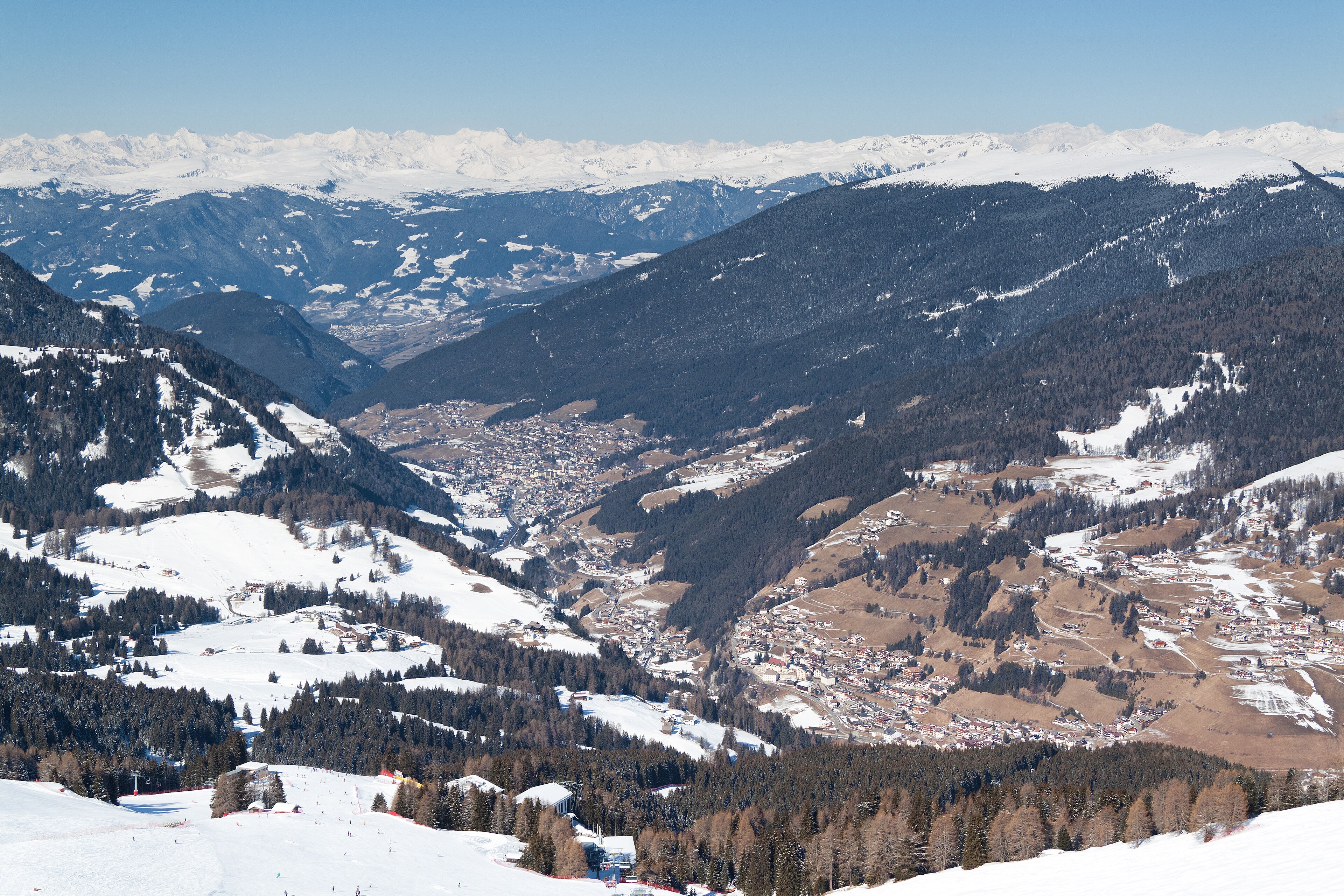
At the top of the Selva-Ciampinoi cable car, at 2,254 metres on the south flank of the Sella massif, the official start of the Freeride Ciampinoi sits 550 metres of gravel road above the cabin door. From there it is 3.13 kilometres and 568 metres of vertical down a graded red trail that has become the calling card of Val Gardena's lift-served riding. It is the same lift that hauls World Cup skiers up the Saslong piste in December, repurposed each summer for bikes, and it sets the tone for a valley where Alpine engineering, UNESCO scenery and a relatively young trail network now coexist.
The Trail Arena: six lines, seven lifts
The Trail Arena Val Gardena is the structured bike-park product, a single ticket that opens seven lifts to riders with bikes: Dantercepies, Cir, Piz Seteur, Gran Paradiso, Ciampinoi, Piza Pranseies and Costabella. Inside that envelope sit six graded trails totalling roughly 14 kilometres of descent.
- Freeride Ciampinoi (red, 3.13 km, 568 m vert) — the showpiece. Steep, rocky in places, demanding fitness as well as skill.
- Easy Jump Trail (blue, 2.2 km, 192 m vert) — tabletops and rollers off the Piz Seteur cable car.
- Family Flow Trail (blue, 3.5 km, 213 m vert) — a long, mellow flow line from the same lift.
- Paravis Trail (green, 2.8 km, 164 m vert) — a green that earns its grade, accessed via Piz Seteur and Gran Paradiso.
- Cir Tiera (blue, 1.4 km) and Cir Giara (green, 1.6 km) — the Dantercepies side, useful warm-ups before tackling Ciampinoi.
The structure suits mixed-ability groups: a strong intermediate can lap Ciampinoi while less experienced riders rotate Piz Seteur all day on the same lift pass.
Sellaronda MTB Tour: a UNESCO loop on lifts
Above the bike park sits the Sellaronda MTB Tour, the lift-assisted circumnavigation of the Sella massif via the four Dolomite passes — Gardena, Campolongo, Pordoi and Sella. Riders choose a direction: the clockwise version runs roughly 58 kilometres with about 3,730 metres of lift-aided climbing (net pedalling closer to 450 m), while counter-clockwise covers around 56 kilometres with more rider input (closer to 1,020 m of pedalled climb). It draws on the same Dolomiti SuperSummer infrastructure that serves skiers in winter and takes most riders five to nine hours to complete. The route passes the Ciampinoi station, which is why many guides recommend a day on the bike-park trails before attempting the loop — the descents on the Sellaronda are not as graded as Trail Arena lines, and tired legs find the singletrack sections unforgiving.
Season: a tighter window than it looks
The headline season runs mid-June to early October, but the lift calendar tightens as autumn approaches. In 2025 the Trail Arena operated 14 June to 5 October, with the Ciampinoi cable car running roughly early June to early October. Several feeder lifts close earlier: Gran Paradiso typically winds down in early September, Cir and Piza Pranseies in mid-September, Costabella around the third week of September. The Sellaronda MTB Tour itself was published with a 2026 window of 13 June to 27 September.
Practical implication: July is reliable but busy, early September offers the best balance of weather, quieter trails and a full lift map, and late September into early October is for riders who can plan around partial closures and afternoon storms.
Getting there without flying short-haul
Val Gardena has no train station of its own, but the rail approach is genuinely viable. The nearest stations are Ponte Gardena (18 km), Chiusa (23 km), Bressanone (34 km) and Bolzano (40 km), all on the Brenner corridor that links Munich, Innsbruck, Verona and Milan. From Bolzano, SAD bus line 350 runs into the valley: roughly one hour to Ortisei and around 80 minutes to Selva, the village at the base of the Ciampinoi cable car. Bikes are accepted on regional trains and on most SAD coaches outside peak commuter hours. For riders comparing footprints, the Munich-Verona rail leg and a 90-minute bus transfer compares favourably with a short-haul flight into Innsbruck or Verona Villafranca followed by a car hire.
Where to base, in context
Selva (Wolkenstein) sits closest to the Ciampinoi and Dantercepies lifts and is the logical base for riders prioritising downhill laps. Santa Cristina is quieter and central to the Sellaronda loop. Ortisei is the largest village, better connected by bus and more useful for non-riding partners. Accommodation across the valley spans family-run garni pensions, alpine refuges higher on the network and full-service hotels at village level — book early for the July and early-September windows, when the Sellaronda crowd and the Dolomiti SuperSummer pass overlap.
Worth knowing before booking
- Bike pass and Dolomiti SuperSummer card are separate products; a Trail Arena day ticket covered the seven park lifts at €53 adult in 2025.
- Ciampinoi day ticket (lift plus track) was €38 in 2024.
- Helmets are mandatory on lift-served trails; full-face and pads are strongly advised on Freeride Ciampinoi.
- Afternoon thunderstorms are routine from mid-July; locals ride early and finish by mid-afternoon.
The valley does not host a UCI World Cup downhill or an EWS round, and riders who arrive expecting Crankworx-style infrastructure will find something more measured — a compact, well-signed network in extraordinary surroundings, with a serious descent at its core and the Sellaronda as the bigger-day reward.
Full POV of the Freeride Ciampinoi descent, the headline red line of Val Gardena's Trail Arena.
Find a hotel in Val Gardena
Same prices as Booking.com. 1 tonne CO₂ retired per stay. €5 credit on signup.
Search now →