Engadin Mountain Bike Guide: Corviglia Flow Trails & Alpine Singletrack
High above St. Moritz, the Corviglia funicular delivers riders into a 400-kilometre signposted network where 480-vertical-metre flow trails, Olympic-era descent lines and high-alpine singletrack share the same lift ticket.
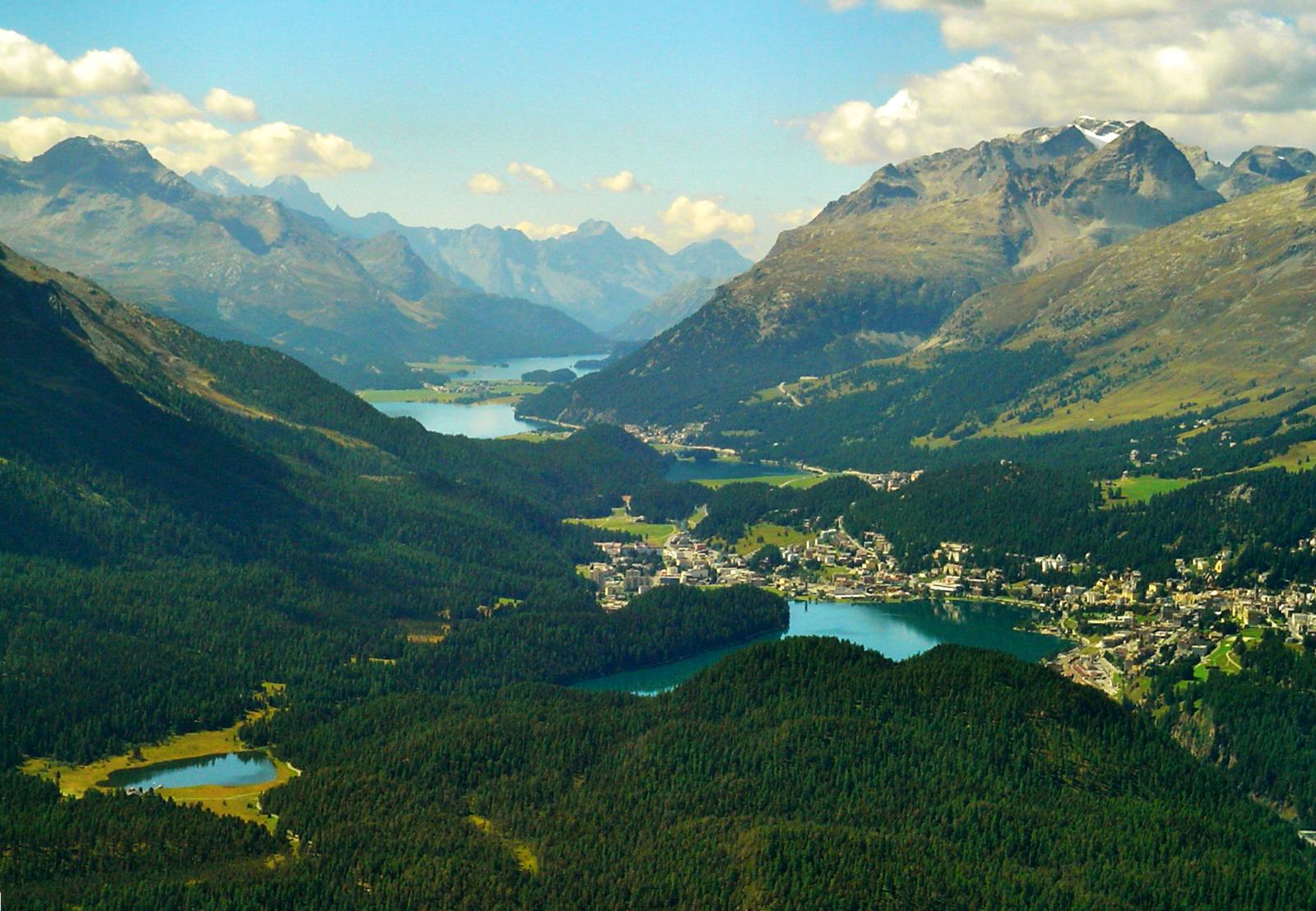

The Olympia Flow Trail drops 480 vertical metres in 3.7 kilometres, tracing the line of the 1948 St. Moritz Winter Olympic downhill course before depositing riders, slightly winded, at the Chantarella mid-station above the lake. It is one descent inside a 400-kilometre signposted network that stretches from larch forest at 1,800 metres to the rocky shoulder of Piz Nair at 3,057 metres — and it sets the tone for what the Engadin Bike Region actually is: a high-altitude lift-served playground that rewards good legs and good lungs in roughly equal measure.
The signature descents
Corviglia is the centrepiece. Three lift-served flow trails form the spine of the network. The Marmotta Flow Trail is the gentle 2.2-kilometre blue, a confidence-builder for families and first-time flow riders. The Olympia Flow Trail — blue/red in character — winds for 3.7 kilometres from the Corviglia mountain station down through Sass Runzöl and Alp Nova into stone-pine forest above Chantarella. The WM Flow Trail, built for the 2017 Marathon World Championships, is the most playful of the three: a sequence of bermed rollers and pump sections that includes a much-photographed 360-degree carousel curve at Alp Giop before flowing on toward the Trutz Hut.
For riders who came for technical alpine terrain rather than groomed berms, the lift to Piz Nair opens the high country. The descent from the summit down Val Schlattain is a serious black-graded line through scree, slab and exposed switchbacks. The Suvretta Loop (route 671) threads almost six kilometres of singletrack down the Val Suvretta da San Murezzan from the Suvretta Pass — high-alpine, technical, with no margin for casual riding when weather closes in. The Padella–Corviglia–Panorama route (672) stitches a longer day on the ridge above the Engadin lakes.
How the bike park actually works
The Engadin is not a single-mountain bike park in the Whistler or Lenzerheide sense — it is a multi-valley network that uses scheduled mountain railways for uplift. The key bike-permitted lifts are the Chantarella–Corviglia funicular from St. Moritz Dorf, the Signalbahn from St. Moritz Bad, the Marguns gondola from Celerina, the Piz Nair cable car above Corviglia, and the Muottas Muragl funicular on the opposite side of the valley. Day tickets are sold in three altitude tiers — up to 2,300 m, 2,500 m, or 3,000 m — so a half-day on Marmotta costs considerably less than a full day topping out at Piz Nair.
2026 season window
Lifts open in staggered phases. The Signalbahn and Muottas Muragl begin summer service on 6 June 2026; the Corviglia–Marguns system follows on 27 June 2026. Most lifts run through mid-September, with the high Piz Nair cable car the first to close as autumn snow returns. July and early September are the sweet spots — long daylight, hero dirt, and noticeably thinner crowds on weekdays.
Getting there without a car
The Engadin is one of the most reachable major bike destinations in the Alps by rail. From Zurich Airport, the journey to St. Moritz runs roughly 4 hours 15 minutes: airport to Zurich Hauptbahnhof, an InterCity to Chur, then the Rhaetian Railway's UNESCO-listed Albula line climbing through tunnels and viaducts to St. Moritz. Bikes need a separate bike ticket and a reservation on Rhaetian Railway services in summer; capacity is real, not theoretical, and weekend trains fill. PostBuses to outlying trailheads carry bikes on rear racks, again subject to space.
The train-versus-flight calculus matters here. A Zurich-to-St. Moritz rail journey produces a fraction of the carbon of an equivalent short-haul flight plus transfer, and the Rhaetian network connects directly into Italian, Austrian and southern German services — a credible argument for arriving without a hire car.
Shoulder versus peak
Peak season is mid-July through mid-August: every lift running, every refuge open, and St. Moritz at its most expensive. Late June can be exceptional if the winter snowpack has cleared from the high trails, though Val Suvretta and the Piz Nair descents sometimes hold snow patches into early July. September is the quiet connoisseur's window — stable high pressure, golden larches by month-end, and lift queues that effectively disappear midweek. Afternoon thunderstorms remain a real factor all summer above 2,500 metres; early starts are not a stylistic choice.
Where to base
St. Moritz Dorf and St. Moritz Bad sit closest to the Corviglia and Signal lifts and carry the highest room rates. Celerina, two kilometres down-valley, offers direct access to the Marguns gondola and noticeably calmer evenings. Pontresina places riders at the foot of Muottas Muragl and the Bernina trails. Samedan, the valley's working town, is the budget-conscious choice and a five-minute train ride from any lift base. Bike-friendly hotels typically include lift transport and bike storage from the second night, an Engadin convention worth confirming at booking.
Jamie Nicoll follows Max Schumann down a full POV run of the Corviglia Flowtrail above St. Moritz.
Find a hotel in Engadin
Same prices as Booking.com. 1 tonne CO₂ retired per stay. €5 credit on signup.
Search now →