Independent Hotel Show Miami 2026: Where to Stay on South Beach
Miami in mid-September wears its humidity like a second skin, but the Independent Hotel Show pulls a crowd that already knows the drill: boutique operators and design buyers from Vancouver to Santiago, arriving at Miami Beach Convention Center with mood-boards, deal-flow spreadsheets and an eye on the city's independent hotel explosion. The venue sits in the heart of South Beach, so evenings bleed naturally into Ocean Drive cocktails, Wynwood gallery openings and the kind of architectural tourism that passes for research when you're sourcing lobby furniture. Two full days of exhibitors, panels and networking mean most visitors extend the trip by a night or two—Miami rewards the lingering traveller, especially one attuned to interiors, neighbourhood character and the stories behind a check-in desk.
Why Miami Beach Convention Center anchors the show
The Miami Beach Convention Center occupies a wedge of reclaimed land between the beach and the Intracoastal, a location that neatly summarises the city's gift for making infrastructure feel like destination. Built in the fifties, rebuilt in the nineties and expanded again in 2018, the venue has hosted everything from yacht shows to Art Basel satellites. For the Independent Hotel Show, the appeal is twofold: walkable access to the country's densest cluster of Art Deco lodging, and a fifteen-minute Uber to Wynwood, where many of the continent's most Instagrammed boutique properties draw direct inspiration from street-art murals and adaptive-reuse warehouses.
The convention floor itself is column-free, naturally lit and designed for the sort of meandering that trade shows depend upon. Exhibitors range from Italian tile suppliers to Canadian linen startups, and the crowd skews owner-operator rather than corporate franchise. That mix generates a specific energy—intimate, competitive, surprisingly collegial. Panels run in side rooms; coffee breaks spill onto an outdoor terrace with views of the Collins Canal. If you've attended the London or Amsterdam editions, expect the same curatorial rigour but with palm trees and a looser dress code.
The Art Deco corridor and what it teaches hoteliers
Ocean Drive, Collins Avenue and Washington Avenue form a three-street showcase of preservation-district lodging, much of it still operating as independent hotels seventy or eighty years after opening. For show attendees, this is the live textbook: how to maintain historic facade requirements while installing modern HVAC, how to balance listed-building restrictions with guest expectations for USB ports and rain showers, how to market heritage without lapsing into theme-park nostalgia. Many properties open their lobbies for informal evening gatherings during the show; it is not unusual to find a Peruvian owner comparing notes with a Québécois designer over mojitos in a terrazzo-floored bar that has looked identical since 1938.
The architecture itself—pastel stucco, porthole windows, neon cursive signage—has been photographed into cliché, but walking it at dawn or dusk still delivers. The scale is human, the street grid legible, and the density of independent operators per block remains unmatched in North America. Visitors often schedule early-morning reconnaissance walks, notebook in hand, cataloguing details: the way a certain property uses vertical garden panels to soften a narrow facade, the lobby furniture arrangement that doubles as co-working space, the check-in desk carved from a single slab of Keys limestone.
Wynwood's design-led independents as case studies
Twenty minutes west, Wynwood has become the de facto pilgrimage site for hoteliers interested in adaptive reuse and millennial-traveller aesthetics. What was a warehouse district ten years ago now hosts a handful of design-forward properties—raw concrete, floor-to-ceiling murals, rooftop bars with improbable sightlines over the Miami skyline—that regularly appear in trade publications and Instagram feeds. The neighbourhood's transformation from industrial void to culture quarter happened fast, and the hotel stock reflects that velocity: most properties opened within the past five years, many in buildings that previously stored textiles or auto parts.
For show attendees, a Wynwood site visit offers immediate ROI. You see how a 12-room property can command leisure rates by anchoring itself to gallery openings and food-hall foot traffic. You observe how communal spaces—courtyards, podcasting booths, record-player lounges—drive social-media content without requiring traditional marketing spend. You note the partnerships: local coffee roasters in the breakfast nook, neighbourhood artists rotating works in the corridors, breweries sponsoring evening events in the lobby. The model is replicable in similar districts across the Americas, which is precisely why so many attendees block out a half-day to walk Wynwood end to end.
Brickell for the business-traveller baseline
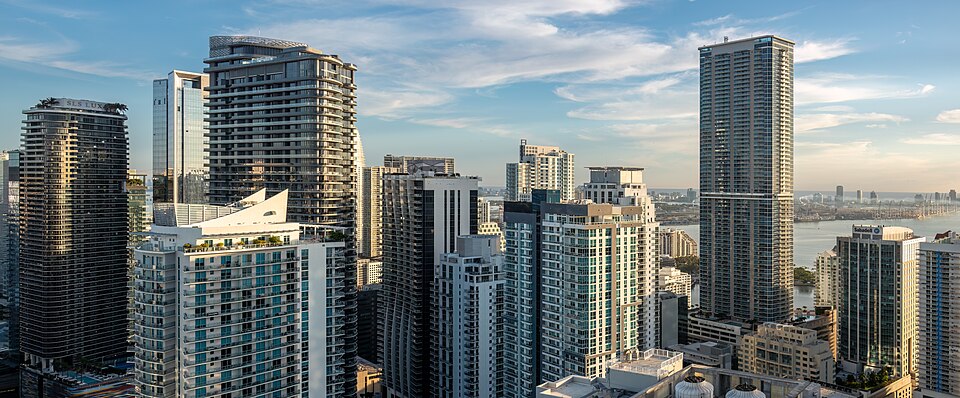
South of downtown, Brickell operates as Miami's financial district—glass towers, corporate tenants, expense-account restaurants—and its hotel scene skews toward the polished, the efficient, the four-star international. For independent operators benchmarking against chain competition, Brickell is useful fieldwork. You see what Marriott and Hyatt are offering at the same price point, how they configure meeting space, what amenities they bundle into the rate. Then you reverse-engineer: where can a 40-room independent out-execute on service, on local flavour, on the intangibles that loyalty programmes struggle to replicate?
Several newer Brickell properties attempt precisely that balance—independent ownership, design-led interiors, but with the infrastructure (keyless entry, 24-hour room service, concierge app) that corporate travellers expect. They serve as case studies in hybrid strategy, and many show attendees schedule property tours during the event. The neighbourhood also offers practical advantages: direct Metromover access to the convention centre, late-night dining that doesn't require a car, and hotel bars frequented by locals rather than tourists, which provides a useful sanity check on pricing and programming assumptions.
Timing, climate and the September shoulder-season calculation
Mid-September sits at the tail of Miami's wet season, which means afternoon thunderstorms arrive with metronomic reliability around 15:00, drench the city for thirty minutes, then vanish. Humidity hovers in the high seventies; temperatures routinely touch thirty-two Celsius. For northern attendees, the climate shock is real. Lightweight linen, multiple outfit changes and aggressive air-conditioning become non-negotiable. But shoulder season also delivers advantages: lower hotel rates than the winter peak, thinner crowds at restaurants, and a local population that has not yet ceded the city to snowbirds and cruise passengers.
Hurricane season technically runs through November, though September historically skews quieter than August. The show organisers monitor forecasts closely, and the convention centre itself was built to withstand Category 3 conditions. For hoteliers attending, the timing offers a natural conversation starter around climate resilience, storm protocols and the insurance mathematics that underpin coastal hospitality. Several evening panels typically address these themes, with Miami operators sharing candid post-mortems from past hurricane seasons.
Extending the trip: what the design-curious actually do
Most attendees arrive the evening before the show opens and depart the evening it closes, but a meaningful minority tack on two or three nights to explore the city's lodging ecosystem more thoroughly. Common itineraries include: a morning at the Bass Museum to see its renovated interiors and sculpture garden; an afternoon drive to Coral Gables to photograph the Biltmore and study its approach to heritage luxury; an evening in Little Havana for the cigar-and-rum ritual that still anchors dozens of independent guesthouses across the Caribbean. These extensions are partly leisure, partly competitive intelligence.
The city's food scene—stone-crab season opens in October, but ceviche and Cuban sandwiches require no calendar—provides ample material for operator notebooks. How does a restaurant build regulars in a transient city? What does 'local' mean when half the population arrived within the past decade? How do you price a experience that locals consider everyday but tourists photograph? The answers matter to hoteliers trying to curate neighbourhood guides or negotiate restaurant partnerships, and Miami's density of examples makes it an efficient learning environment.
The IMPT booking model and what it funds
Reserving accommodation via IMPT Travel's app delivers the same nightly rate you would pay booking direct—no markup, no hidden fees—but attaches a climate commitment to every stay. One tonne of UN-verified carbon dioxide gets permanently retired from circulation, funded from the commission IMPT earns from the property. You also accrue five percent Goodness rewards, redeemable against future bookings. Free cancellation applies to most reservations, and the process involves three taps: search, select, confirm.
For trade-show attendees already evaluating sustainability vendors and carbon-accounting platforms, the model demonstrates product-market fit in real time. You see how offset funding can be embedded in an existing transaction without requiring the traveller to opt in, calculate or pay extra. The tonnes retired are serialised, third-party verified and traceable on public registries. It is straightforward infrastructure, and it scales across property types—Art Deco boutiques, Wynwood design hotels, Brickell business lodges—without requiring the hotel itself to change supplier relationships or rate structures.
Where to stay — chosen for character
The Betsy Hotel
Colonial Revival architecture meets contemporary art program, with a rooftop terrace, writer's room and pianist in the lobby most evenings. The credible choice for attendees who want both heritage credibility and cultural programming.
The Sagamore Hotel
All-white interiors offset by rotating gallery-quality contemporary art installations. Pool scene skews social; rooms are minimalist. Appeals to design buyers seeking inspiration beyond the show floor.
The Plymouth Hotel
Streamline Moderne facade restored to period accuracy, modest room count, rooftop bar with unobstructed ocean views. The practical alternative for operators on tighter budgets who still want architectural context.
Gramps Hotel Wynwood
Compact urban lodge above a live-music bar, murals on every surface, communal tables in the lobby. The base camp for attendees scheduling Wynwood property tours and wanting immersion over convenience.
EAST Miami
Floor-to-ceiling glass tower with rooftop pool, Quinto La Huella restaurant and harbour views. Swire Hotels' design-forward take on the business hotel, useful for benchmarking hybrid-traveller strategy.
Life House Little Havana
Adaptive reuse of a sixties motel, now operating under the Life House soft brand. Compact rooms, neighbourhood immersion, case study in how to reposition tired assets for millennial leisure travellers.
Kimpton EPIC Hotel
Riverfront location with yacht-slip views, pet-friendly policies and rooftop pool. Demonstrates how Kimpton balances independent ethos within IHG infrastructure—relevant for operators considering soft-brand affiliations.
Faena Hotel Miami Beach
Gold-leaf interiors, ocean-facing theatre, contemporary art collections and a cathedral-like spa. The aspirational benchmark for experiential luxury; price point reflects it but the design lessons are free if you walk the public spaces.
Getting there and moving around
Miami International Airport lies thirteen kilometres west of South Beach; the journey into the Art Deco district takes twenty to forty minutes depending on traffic and route. Rideshare is default for most visitors—predictable pricing, direct drop-off—though the 150 airport bus runs to Washington Avenue for those unbothered by extra time. If you are staying in Brickell or downtown, the Metrorail connects to airport station, then you switch to Metromover for final approach. Car hire makes sense only if your itinerary includes Coral Gables, Coconut Grove or the Keys; within Miami Beach and Wynwood, a car becomes a parking liability.
The convention centre itself is served by multiple bus routes along Convention Center Drive, and the free South Beach trolley loops through the Art Deco district every fifteen minutes during daylight hours. Walking remains the most practical option for anyone staying between Fifth Street and Twenty-First Street—the district is compact, pavements are wide, and you will notice architectural details that matter to your business. Wynwood and Brickell require rideshare or the Metromover; budget ten to twenty minutes door-to-door from South Beach.
The show floor opens at 09:00 both days, with registration from 08:00. Morning sessions draw the largest crowds; by mid-afternoon the pace eases and one-on-one conversations become feasible. Evening programming—receptions, partner events, informal property tours—runs until 22:00 or later, and Miami's dining scene operates on a late clock. If you are juggling European or West Coast time zones, plan accordingly; jet lag and September humidity form an effective collaboration against productivity.
Departure logistics depend on your closing-night plans. Many attendees schedule late flights on the seventeenth to maximise floor time, then head straight to MIA from the venue. Others extend to the eighteenth for decompression, site visits or the beach access they have been staring at all week. Either way, factor in airport security queues—MIA moves volume, and even TSA PreCheck lines can stretch during afternoon departures. If you are international, allow three hours; domestic, two is usually sufficient but not guaranteed.
Questions readers ask
How far is the convention centre from Ocean Drive?
Miami Beach Convention Center sits roughly 700 metres west of Ocean Drive, a ten-to-twelve-minute walk through the Art Deco Historic District. The route is flat, shaded intermittently by palms and building overhangs, and takes you past several notable properties and cafés. Rideshare is overkill for this distance unless you are moving luggage.
What is the climate like in mid-September?
Expect daily highs near thirty-two Celsius, humidity in the high seventies and afternoon thunderstorms that arrive with theatrical punctuality around 15:00. The rain is heavy but brief; within thirty minutes the skies clear and steam rises from the pavements. Pack lightweight fabrics, bring an umbrella and embrace aggressive air-conditioning indoors.
Can I walk between South Beach and Wynwood?
Not practically. The distance is seven kilometres, much of it along high-traffic corridors without pedestrian infrastructure. Rideshare takes fifteen to twenty minutes and costs ten to fifteen dollars depending on surge. The Metromover does not serve Wynwood directly, so car or rideshare remains the default.
Is September hurricane season?
Yes, though September historically sees fewer named storms than August or October. The convention centre was built to Category 3 standards, and show organisers monitor forecasts closely. Most attendees proceed as planned; travel insurance that covers weather disruption is nonetheless prudent, especially if you are flying intercontinental.
Do I need a car for the duration of the show?
No. If you are staying in South Beach or Brickell, rideshare and public transport cover your needs efficiently. A car becomes useful only if you plan excursions to Coral Gables, Key Biscayne or beyond. Parking at South Beach hotels is expensive and often valet-only, adding friction you do not need during a trade show.
What does the IMPT booking process involve?
Three steps via the IMPT Travel app: search by date and location, select your property, confirm the reservation. The rate matches what you would pay direct, free cancellation applies to most stays, and one tonne of UN-verified CO₂ is retired per booking, funded from IMPT's commission. You also earn five percent Goodness rewards for future use.
Are there evening events outside the official schedule?
Informally, yes. Several South Beach properties host lobby receptions or rooftop gatherings for attendees, and Wynwood galleries often coordinate openings to coincide with the show dates. The official programme lists partner events, but much of the networking happens spontaneously in hotel bars and restaurant patios between 19:00 and midnight.
How do I visit properties in Wynwood during the show?
Most Wynwood hotels welcome walk-ins to public spaces—lobbies, courtyards, ground-floor bars—during daylight hours. For guided tours or access to guest floors, email in advance or ask the concierge to arrange it. Alternatively, several show exhibitors organise informal group site visits on the evening of the sixteenth; details circulate via the event app.
What is the best time to arrive if I want to explore before the show?
Landing on the fourteenth gives you the fifteenth for reconnaissance: walk the Art Deco corridor in the morning before heat peaks, visit Wynwood galleries in the afternoon, have dinner in Little Havana or Brickell. This also buffers against flight delays and lets you adjust to the time zone if you are coming from the West Coast or internationally.
Can I extend my stay affordably after the show?
Shoulder-season rates in September are significantly lower than winter peak, so extending by two or three nights remains budget-feasible. Midweek rates especially—if the show closes on a Wednesday, staying through Friday—offer better value than weekend premiums. Book early for the properties closest to the convention centre; availability tightens as the event date approaches.
The Independent Hotel Show delivers concentrated exposure to suppliers, operators and ideas that matter to the boutique segment, but Miami itself provides the deeper curriculum. Walking the Art Deco blocks at dawn, cataloguing adaptive-reuse successes in Wynwood, benchmarking service standards in Brickell—these extensions turn a two-day trade event into a week of competitive intelligence. Booking via IMPT Travel keeps the transaction simple: same rate as direct, free cancellation on most properties, one tonne of verified carbon retirement per stay funded from commission, five percent rewards accruing automatically. The show floor tells you what is new; the city shows you what works. Arrive early, stay late and take notes.